Air Pollution

Anthropogenic particles are found in dust storms, volcanic ash, and the burning of fossil fuels. Rapidly increasing exposure to anthropogenic particulate pollution (e.g., industrial emissions, combustion-based engines) and man-made engineered nanomaterials (ENMs) represents a major global health concern today. Recent epidemiological studies demonstrate the correlation between ambient particulate air pollution and cardiovascular events. This is a special concern given that cardiovascular disease is the leading cause of death worldwide.
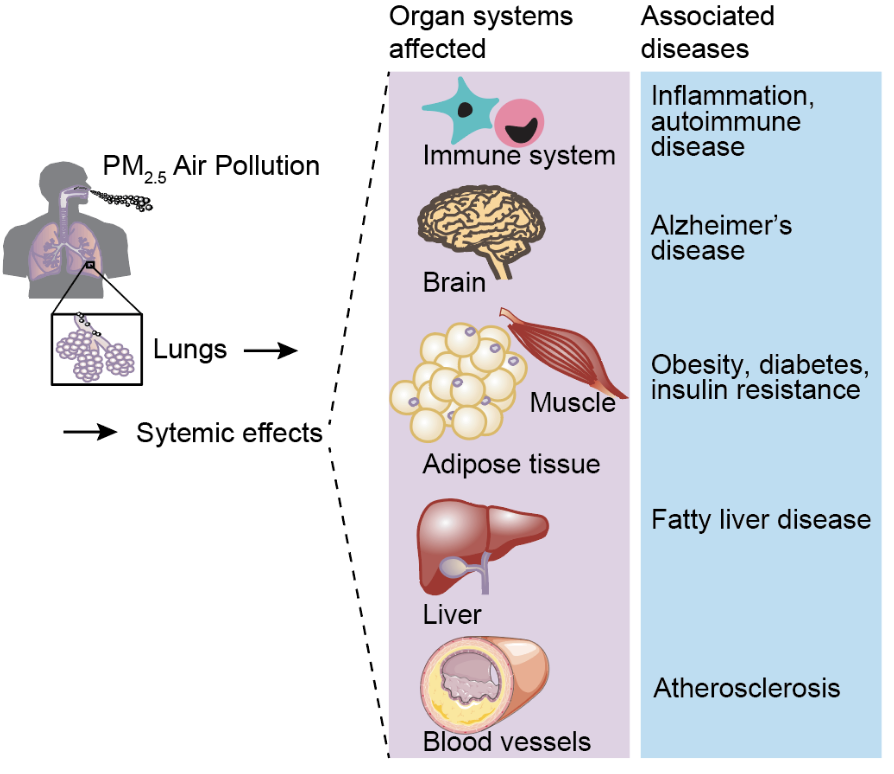
Our laboratory in collaboration with Dr. Sanjay Rajagopalan’s team significantly advanced the understanding of particulate matter air pollution, particularly PM2.5, and its implications for health. Our research has primarily focused on the physiological impacts of PM2.5, including its associations with oxidative stress, inflammation, and metabolic disorders.
We have explored the mechanisms through which PM2.5 contributes to inflammation and insulin resistance. Our findings indicate the involvement of CCR2 pathways, illustrating how PM2.5 exposure can exacerbate metabolic disorders by promoting inflammation in adipose tissue and influencing glucose metabolism in skeletal muscle. All these insights enhance the understanding of how air pollution can affect metabolic homeostasis, which has significant public health implications concerning diabetes and obesity. Our research underscores the correlation between PM2.5 exposure and various pathophysiological mechanisms that exacerbate cardiovascular diseases, particularly atherosclerosis. We integrated new paradigms in understanding the role of PM2.5 in atherosclerosis, revealing how airborne particulate matter not only contributes to direct endothelial injury and inflammation but also influences broader metabolic and genomic factors in disease progression.
Our research on PM2.5 not only informs clinical approaches to managing pollution-related health issues but also calls for policy considerations to improve air quality and safeguard public health on a larger scale.
We Published These!
- Liu C, Fonken LK, Wang A, Maiseyeu A, Bai Y, Wang T-Y, Maurya S, Ko Y-A, Periasamy M, Dvonch T, Morishita M, Brook RD, Harkema J, Ying Z, Mukherjee B, Sun Q, Nelson RJ, Rajagopalan S. Central IKKβ inhibition prevents air pollution mediated peripheral inflammation and exaggeration of type II diabetes. Part Fibre Toxicol. 2014;11:53.
- Deiuliis JA, Kampfrath T, Zhong J, Oghumu S, Maiseyeu A, Chen LC, Sun Q, Satoskar AR, Rajagopalan S. Pulmonary T cell activation in response to chronic particulate air pollution. Am J Physiol Lung Cell Mol Physiol. 2012;302:L399–409.
- Xu X, Rao X, Wang T-Y, Jiang SY, Ying Z, Liu C, Wang A, Zhong M, Deiuliis JA, Maiseyeu A, Rajagopalan S, Lippmann M, Chen L-C, Sun Q. Effect of co-exposure to nickel and particulate matter on insulin resistance and mitochondrial dysfunction in a mouse model. Part Fibre Toxicol. 2012;9:40.
- Sun L, Liu C, Xu X, Ying Z, Maiseyeu A, Wang A, Allen K, Lewandowski RP, Bramble LA, Morishita M, Wagner JG, Dvonch J, Sun Z, Yan X, Brook RD, Rajagopalan S, Harkema JR, Sun Q, Fan Z. Ambient fine particulate matter and ozone exposures induce inflammation in epicardial and perirenal adipose tissues in rats fed a high fructose diet. Part Fibre Toxicol. 2013;10:43.
- Kampfrath T, Maiseyeu A, Ying Z, Shah Z, Deiuliis JA, Xu X, Kherada N, Brook RD, Reddy KM, Padture NP, Parthasarathy S, Chen LC, Moffatt-Bruce S, Sun Q, Morawietz H, Rajagopalan S. Chronic fine particulate matter exposure induces systemic vascular dysfunction via NADPH oxidase and TLR4 pathways. Circ Res. 2011;108:716–726.
- Liu C, Xu X, Bai Y, Wang T-Y, Rao X, Wang A, Sun L, Ying Z, Gushchina L, Maiseyeu A, Morishita M, Sun Q, Harkema JR, Rajagopalan S. Air pollution-mediated susceptibility to inflammation and insulin resistance: influence of CCR2 pathways in mice. Environ Health Perspect. 2014;122:17–26.
- Maiseyeu A, Yang H-Y, Ramanathan G, Yin F, Bard RL, Morishita M, Dvonch JT, Wang L, Spino C, Mukherjee B, Badgeley MA, Barajas-Espinosa A, Sun Q, Harkema J, Rajagopalan S, Araujo JA, Brook RD. No effect of acute exposure to coarse particulate matter air pollution in a rural location on high-density lipoprotein function. Inhal Toxicol. 2014;26:23–29.
- Rao X, Zhong J, Maiseyeu A, Gopalakrishnan B, Villamena FA, Chen L-C, Harkema JR, Sun Q, Rajagopalan S. CD36-dependent 7-ketocholesterol accumulation in macrophages mediates progression of atherosclerosis in response to chronic air pollution exposure. Circ Res. 2014;115:770–780.
 Maiseyeu Laboratory