Neurodegenerative Diseases

Targeting Neurodegeneration with Nanoparticles

The controversial 2021 FDA approval of aducanumab highlighted the immense challenge of developing effective Alzheimer’s disease (AD) drugs. AD involves multiple pathways – including amyloid-β, tau, inflammation, cholesterol, and epigenetics – suggesting that simultaneously targeting several may yield better results. However, delivering treatments across the blood-brain barrier (BBB) remains a major roadblock, especially for advanced therapies like gene editing or nanoparticles.

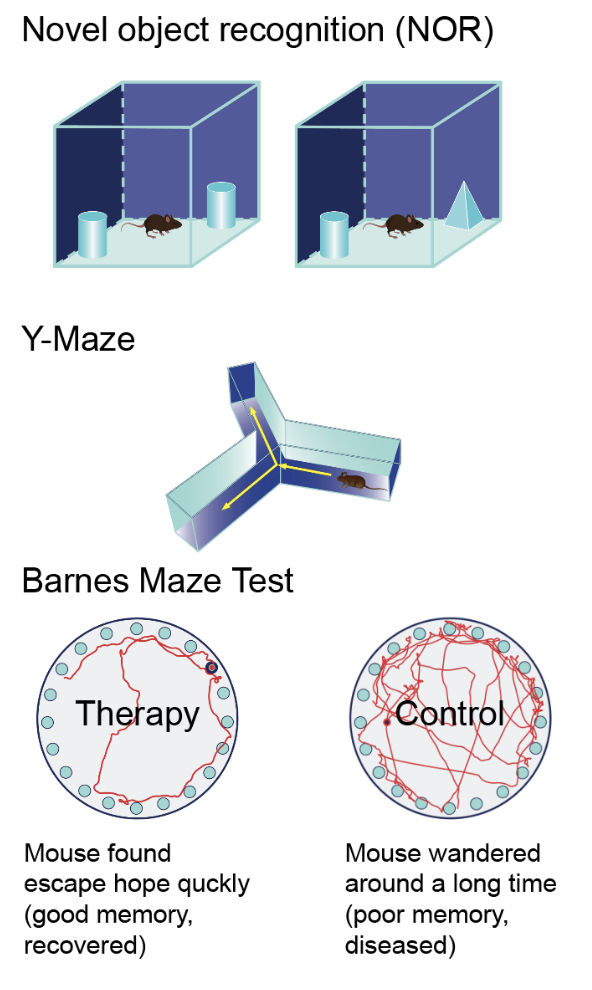
Our Solution: We develop nanoparticle-based therapies designed to overcome these hurdles. Critically, our nanoparticles do not require BBB crossing to be effective. Using advanced AD models, we rigorously test these treatments for their ability to improve memory and cognition. We use various in vitro and in vivo models of AD and other neurodegenerative diseases to develop such treatments and rigorously evaluate beneficial effects on memory and cognition. As such, we use a variety of behavioral tests that aim to assess memory over the course of the treatment:

Novel Object Recognition (NOR) Test: This memory test has two parts. First, mice explore an object to learn it. Later, one object is replaced with a new one, and we record how long the mouse spends near each. We calculate a Recognition Index: (Time at new object – Time at old object) / Total time. This index ranges from -1 to 1. Higher values (more time at the new object) mean better memory. Lower values suggest memory issues, as mice naturally prefer to explore new things.

Y-Maze Test: This assesses spatial memory. A mouse freely explores a Y-shaped maze for 8 minutes while we track its path. We count Spontaneous Alternation (SpAlt) – entering all three arms in order – and Total Arm Entries. The % Spontaneous Alternation is calculated (SpAlt / Total Entries x 100). A higher % SpAlt indicates better spatial memory. Mice naturally prefer new paths, so entering arms sequentially shows they remember where they’ve been. A lower % SpAlt (like revisiting the same arm consecutively) suggests memory problems, as the mouse isn’t recalling recent visits.

Barnes Maze Test: This assesses spatial learning and memory using an elevated circular platform with holes around the edge. One hole leads to a hidden escape box, providing a dark, safe space. Mice naturally dislike bright, open areas, so they learn to find this escape box over several training days. Mice forgetting the escape location show longer searches and check more wrong holes.


We Published These!